

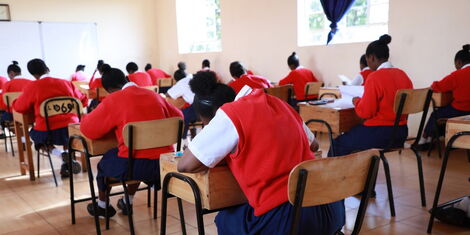
More than 1.1 million students in Grade 9 have reached a major milestone with the release of the 2025 Kenya Junior School Education Assessment (KJSEA) results by Education Cabinet Secretary Julius Ogamba.
The CS presented the new assessment outcome, which places students on the path to senior school placement under the Competency-Based Education (CBE), at an event on Thursday, December 11.
A revamped scoring approach that incorporates both classroom-based assessment and national exams is introduced in this year’s version.
According to the system, school-based tests taken in Grades 7 and 8 account for 20% of a learner’s ultimate transfer score, whereas KJSEA accounts for 60%.
The remaining 20 per cent comes from the Kenya Primary School Education Assessment (KPSEA) score, which now plays a key role in placement to senior school.
NEW BLENDED MODEL
Officials say the blended model is designed to offer a holistic picture of each learner by incorporating practicals, projects, oral assessments, and written tasks alongside the national exam.
The Ministry of Education maintains that this approach aligns with CBE’s goal of emphasising skills, continuous performance, and individual strengths rather than high-stakes competition.
Thursday’s release was deliberately modest, departing from the pomp that surrounded the former Kenya Certificate of Primary Education (KCPE) exams.
According to the Ministry, the quiet approach is meant to reduce pressure on learners and shift public attention away from ranking, mean scores, and national comparisons.
For the first time, the country also received national exam results without merit lists, aggregate scores, or school mean scores. Each learner accesses individual results through the Kenya National Examinations Council (KNEC) portal, which provides a breakdown of performance in the nine subjects written between October 27 and November 3.
KJSEA subject ranking
KNEC also introduced a subject-ranking model that collapses the traditional 500-mark system. Performance is now divided into four bands—Exceeding Expectations, Meeting Expectations, Approaching Expectations, and Below Expectations—spanning eight-point categories.
Scores range from 1 to 8 points, with 8 awarded to learners scoring between 90 and 100 per cent, and 1 point to those scoring between 1 and 10 per cent.
In addition, KNEC generates cluster weights for each learner based on strengths across the nine subjects. For the first time, the exam body issues a recommendation on the pathway a learner is best suited for—Arts and Sports Science, Social Sciences, or Science, Technology, Engineering, and Mathematics (STEM).
The Ministry of Education will use these cluster weights, KNEC’s recommendations, and each learner’s previously declared interests to guide placement.
This marks a significant shift away from the competition-driven 8-4-4 model toward a system that supports learners’ long-term aspirations and strengths.
With the results now live, schools are set to begin transition planning immediately. The ministry is expected to issue further guidance on the senior school placement process in the coming days.